Background
What is Man? A miserable little pile of secrets - André Malraux
I’m going to be honest with you, I thought that quote was from Dracula in the Castlevania video game series. I was pleasantly surprised to learn it is actually from the French novelist André Malraux, and I feel considerably more erudite and learned for attributing the quote to him instead. I also considered a pithy segue into how the attribution of that quote resonates in some fundamental way with Identity Services, but I’ll spare you and get right to it.
For setting up Open OnDemand, I needed to create some identity services in my lab. This seemed like a good opportunity to take a second look at some technologies I’ve considered but ultimately passed over at $JOB for various reasons.
There’s a wonderful presentation by William Brown about Kanidm (see below), in which he covers a bit of the history of identity management systems. One of the things that I recall from William’s talk is that there’s a sort of schism between identity and auth services, with traditional enterprises relying on Active Directory, LDAP, Kerberos and so on, while small, little-known startups like Google and Twitter developed web-centric authentication and authorization systems that would evolve into modern standards like OpenID and OAuth2.
For modern research computing environments, there’s a need to support both. Traditional identity services are essential to shared UNIX environments, while (arguably) more modern technologies like OAuth2 are a requirement for providing services like Jupyter, Open OnDemand, etc.
For my home lab, I’ve decided to check out a simplified LDAP implementation called LLDAP (yes, so light they say it twice).
Since I’ve extolled the virtues of Kanidm, you might be wondering why I didn’t pick it for this project. A couple of reasons:
1. I wanted to do this project sans Docker, and Kani seems to only have
   Docker as a deployment option. Understandable, but I'm a little burnt
   out on the Cloud Native world to be honest.
2. Kani's security focus is laudable, but I'm taking some shortcuts for a
   lab environment that is never exposed to the WAN. Yes.. I know, defense
   in depth, etc.
3. While Kani's Oauth2 implementation would probably work with my Open
   OnDemand environment, but I don't want to go too far off of the beaten
   path.
LLDAP setup on Debian 12
LLDAP is incredibly straight-forward to setup. Since I’m using Debian, I will use the packages from the OpenSUSE build service as such:
apt install curl gpg
echo 'deb http://download.opensuse.org/repositories/home:/Masgalor:/LLDAP/Debian_12/ /' | tee /etc/apt/sources.list.d/home:Masgalor:LLDAP.list
curl -fsSL https://download.opensuse.org/repositories/home:Masgalor:LLDAP/Debian_12/Release.key | gpg --dearmor | tee /etc/apt/trusted.gpg.d/home_Masgalor_LLDAP.gpg > /dev/null
apt update
apt install lldap
Once it’s installed, fire it up:
systemctl enable lldap --nowAnsible configuration
Similar to my other notes, here’s an ansible version of the same thing:
- name: idm
  hosts: idm
  handlers:
    - name: restart lldap
      ansible.builtin.service:
        name: lldap
        state: restarted
  tasks:
    - name: insert lldap apt source
      ansible.builtin.copy:
        src: files/repos/home:Masgalor:LLDAP.list
        dest: /etc/apt/sources.list.d/home:Masgalor:LLDAP.list
    - name: insert lldap repo gpg key
      ansible.builtin.copy:
        src: files/repos/home_Masgalor_LLDAP.gpg
        dest: /etc/apt/trusted.gpg.d/home_Masgalor_LLDAP.gpg
    - name: configure lldap
      ansible.builtin.copy:
        src: files/lldap/lldap_config.toml
        dest: /etc/lldap/lldap_config.toml
      notify:
        - restart lldap
    - name: install lldap
      apt:
        name:
        - lldap
Creating users
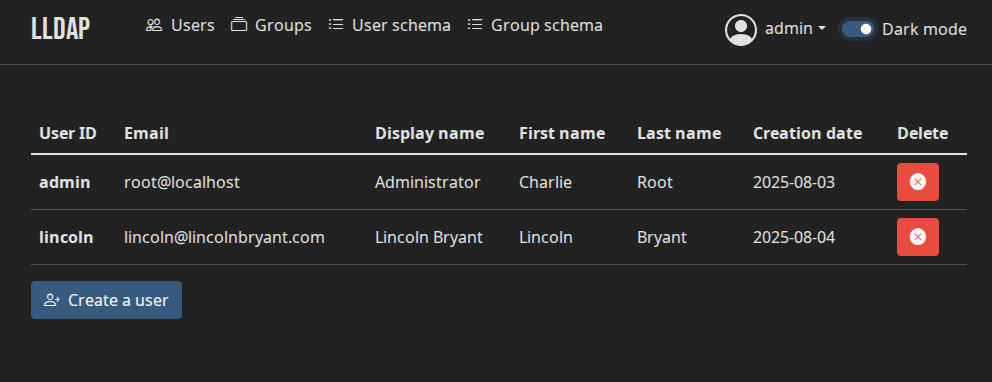
Once LLDAP was up and running, I visited the web portal at lldap:17170 and
changed the default credentials for the admin user, logged in, and created
myself a user.
Testing LLDAP with SSSD
Dex
Most of my experience is with Keycloak, the open source upstream of Red Hat Single Sign-On. While I think Keycloak is an excellent technology at scale, I wanted to roll with something a bit more simple this time around.